Péter Magyar sworn in as Hungary’s prime minister ending 16-year Orbán era
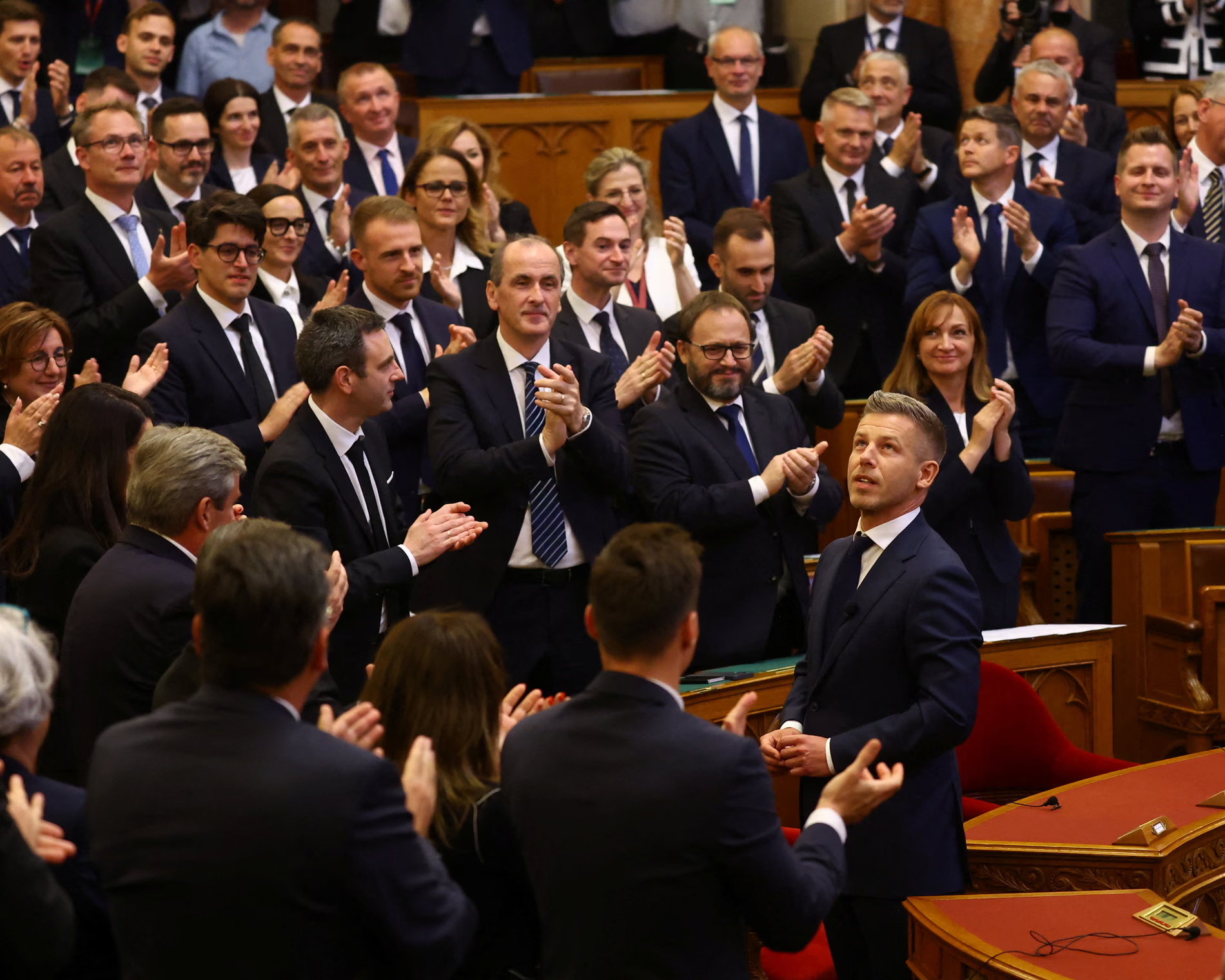
The pro-European centre-right leader Péter Magyar has been sworn in as prime minister of Hungary, marking the official end to Viktor Orbán’s 16 years in power.
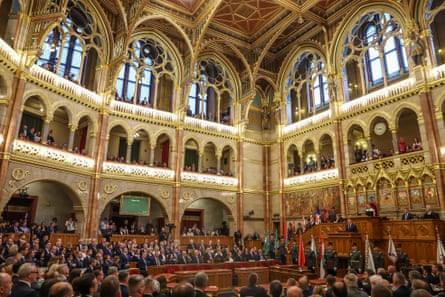
Saturday’s ceremony – during which Magyar had invited people to join him to “write Hungarian history” together and “step through the gate of regime change” – comes a month after his opposition Tisza party won a landslide victory in parliamentary elections.
The result sparked jubilation in Budapest and beyond, as Orbán and his populist, nationalist movement had long been held up by the global far right as an example to emulate.
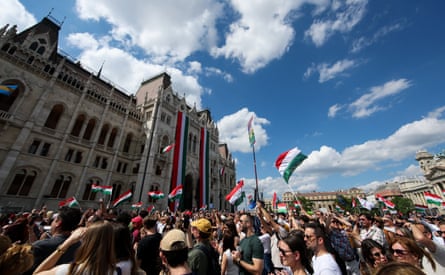
Speaking to the tens of thousands of supporters who had heeded his call to gather outside parliament, the new prime minister described the road to change as very long and often quite bumpy.
But Hungarians could finally rejoice, he added. “Today, every freedom-loving person in the world wants to be a little Hungarian,” he said.
“You have taught the country and the world that it is the most ordinary, flesh-and-blood people that can defeat the most vicious tyranny,” Magyar added to roaring applause.
Earlier he had told parliament that Hungarians had given his party a mandate to launch a “new chapter” in the country’s history. “A mandate not only to change the government, but to change the system as well. To start again.”
Under Orbán’s watch, he said, Hungary had become the most corrupt country in the EU. “Orbán’s associates and the elite have a long way to go until they are confronted with what they have done,” he said, vowing that his government would seek justice against those who, even in the last hours, were trying to “steal everything”.
He reiterated his earlier calls for Orbán-era appointees to resign, asking them to do so by the end of the month. The first should be Tamás Sulyok, he said, in a reference to the president who had, moments earlier, nominated Magyar to form a government. Outside parliament, the crowds roared their approval at the comment.
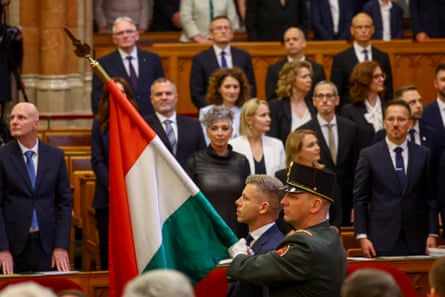
Magyar pledged to build a more inclusive Hungary, one that would be more free, humane and hopeful than under Orbán’s populist nationalist movement. “What connects us will be stronger than what divides us,” he said. “Hungary will be home for every Hungarian, and everyone can feel like they have a place in the Hungarian nation. Family, friends and communities will be able to speak to each other again.”
Early on Saturday, people started pouring into the square outside the country’s neo-Gothic parliament to follow along as the inaugural session was broadcast on large screens. At each glimpse of Magyar, the crowd cheered, while some booed lawmakers from Fidesz and the extreme right Our Homeland party.
Many in the crowd had travelled hours to be there. “This is the first time I feel like it’s good to be Hungarian,” said Erzsébet Medve, 68, who had come from Miskolc in north-eastern Hungary. “I feel like I could cry.”
As a school teacher, she had long watched in frustration as Orbán and his Fidesz government left the education system deprived of funds. “The government had enough money, but they didn’t spend it there.”
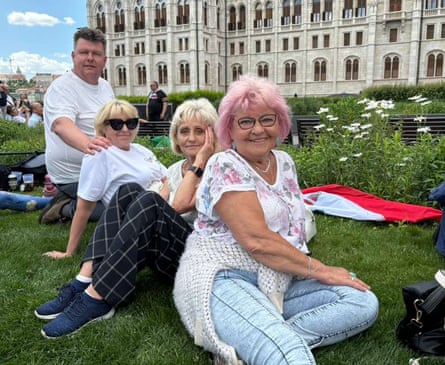
Sitting next to her, Marianna Szűcs, 70, said she hoped Hungary would become a more livable country. “Now we feel like our children and grandchildren have a future here.”
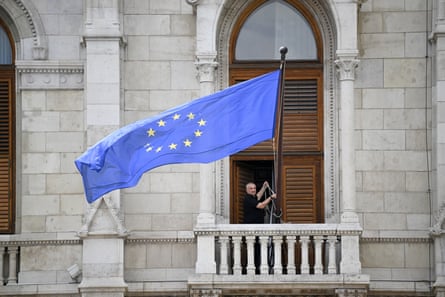
As she spoke, the crowd behind her began cheering wildly as the newly elected speaker of the house, Ágnes Forsthoffer, announced that the EU flag would be returned to the building after it was taken down by Fidesz in 2014.
Szűcs said two of her children had had to move abroad. Both of them had lost their jobs, seemingly after she had spoken out against the Fidesz government, she said. “I’m retired, so they went after them instead,” she said. “Now we hope they will be able to come home.”
The landslide victory, in which Tisza won 141 seats in the 199-seat parliament, was a stunning outcome for Magyar, who until recently had been a little known former member of Fidesz’s elite. He burst into public view in early 2024, after he turned on the party, laying bare the inner workings of a system he described as rotten and accusing officials of expanding their power and wealth at the expense of ordinary Hungarians.
The new parliament marks the first time since the country’s democratisation in 1990 that Orbán – whose decades-long career saw him shift from pro-democracy campaigner to a Russia-friendly figure lauded by the US Maga movement – will not sit in parliament. Late last month Orbán, 62, said he would instead focus on the reorganisation of his movement.
Magyar, 45, has vowed to use his large majority to undo the systems built by Orbán, who had stacked the country’s judiciary, media and state with loyalists as he sought to turn Hungary into a “petri dish for illiberalism”.
Beyond the country’s borders, Magyar has also vowed to rebuild Hungary’s long-strained relationship with the EU and work with the bloc to unlock billions in frozen EU funds.
Hints of this change were symbolically laced through the plans for Saturday’s swearing in: several anthems were to ring out, paying tribute to Hungary’s EU membership, its sizeable Roma minority, and ethnic Hungarians in neighbouring countries, while the lawyer Vilmos Kátai-Németh was to become the country’s first visually impaired minister, taking on the portfolio of social and family affairs.
After years of Orbán’s Hungary lagging behind most of the EU when it came to women’s representation in parliament, more than a quarter of lawmakers will be women – a record high in the country’s post-communist history.
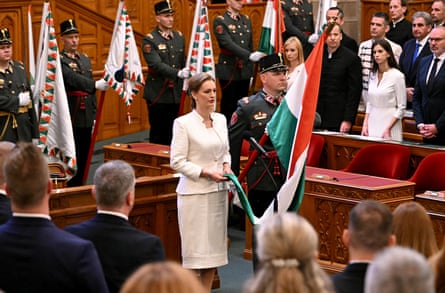
It was not by coincidence that Saturday’s swearing in took place on Europe Day, which commemorates the proposal that gave rise to the modern-day EU, said Anita Orbán, Tisza’s incoming foreign minister. “The message is clear: Hungary’s place is in Europe. Naturally, firmly, and without question,” Orbán, who has no relation to the former prime minister, said on social media.
It was an echo of the actions Magyar has taken in the weeks since the election, as he sought to emphasise the end of what he described as Hungary’s “two-decade-long nightmare”; vowing to suspend broadcasts from state media that functioned as Orbán mouthpieces, calling on Orbán-era appointees to resign; meeting twice with EU officials, and sending back the millions of Hungarian forints donated to him by an Orbán-linked supporter.
The task Magyar and his government face is huge. His promises to fix the country’s crumbling public services will come up against the country’s stagnating economy and a stubbornly high budget deficit. Meanwhile, it remains to be seen how the many Orbán loyalists in media, academia and the judiciary will react to change.
Even so, the mood on Saturday was celebratory in Budapest. At a Tisza booth, crowds lined up to buy party swag, while others milled around waving Hungarian flags.
Even as left of centre and liberal parties are set to be absent from parliament for the first time since 1990, Budapest’s liberal mayor was swift to call on Hungarians to come together to mark the end of Fidesz’s grip on power and hail those who had long stood up to the system.
“Teachers fired, civilians and journalists humiliated, small churches torn apart,” wrote Gergely Karácsony – who has long clashed with Orbán – on social media. “We can finally leave this era behind us – but first, let us remember the everyday heroes and express our gratitude with a farewell to the system.”