‘They have screwed each other pretty badly’: tensions emerge in Netanyahu-Trump alliance
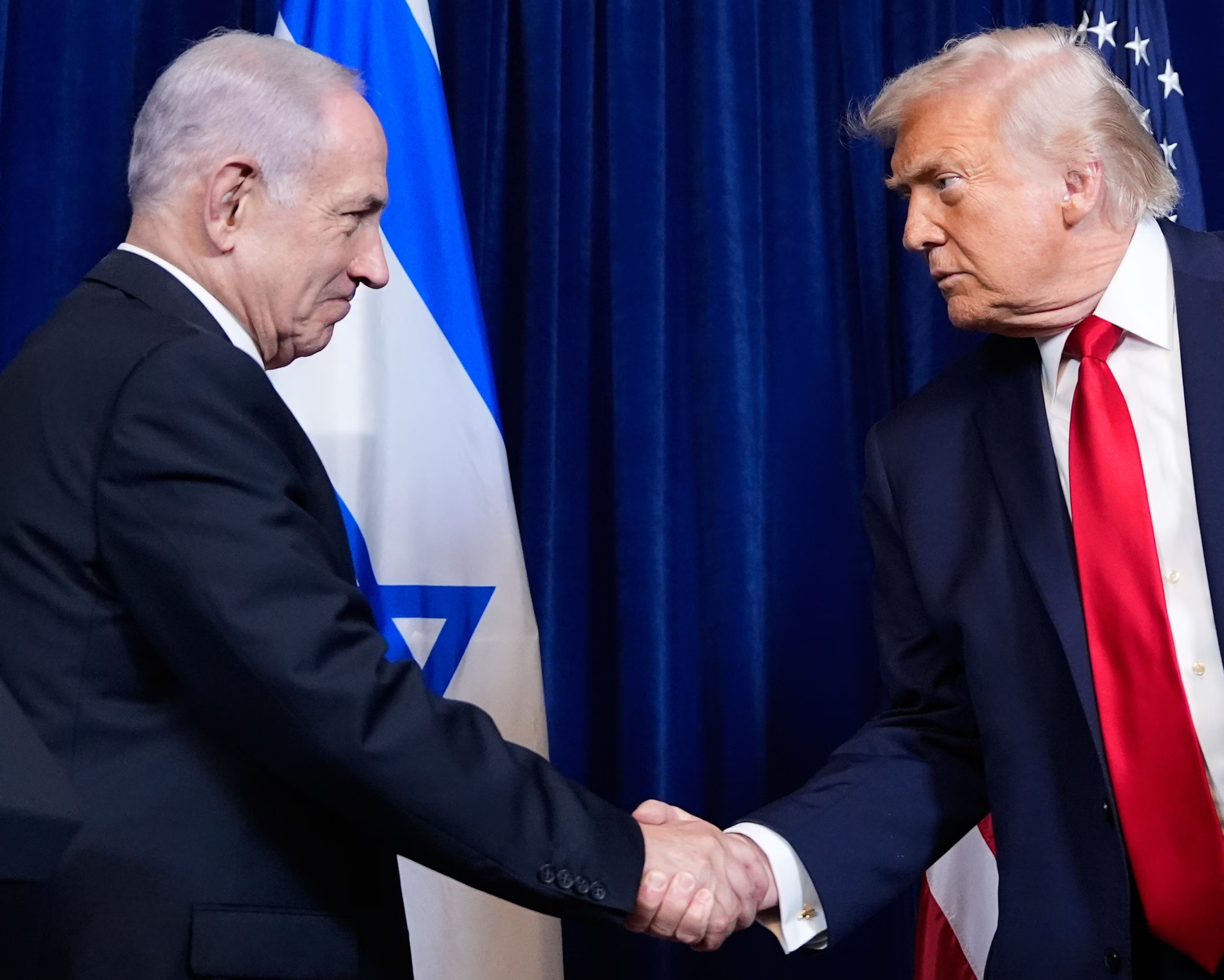
Benjamin Netanyahu interrupted an uncharacteristically long silence over the Iran conflict this week with a video commentary insisting he had “full coordination” with Donald Trump, with whom he spoke “almost daily”.
The insistence that all was rosy in the US-Israeli relationship followed weeks of reports in the domestic press that Israel was no longer being consulted over the Iran conflict, and even less over Pakistani-brokered peace talks. Such is the scepticism over Netanyahu’s trustworthiness among the general public and independent press that the immediate reaction among observers to his video statement was speculation that the reality could be even worse than they had imagined.
“He is doing so much talking about how great the relationship is that it makes me rather concerned about how much tension there is,” said Dahlia Scheindlin, an American-Israeli political consultant and pollster. “I wouldn’t be surprised, as the war is clearly going very poorly from all perspectives related to the original goals.”
The US president and the Israeli prime minister have long presented mirror images of each other. They have both pioneered populist methods to dominate domestic politics, cutting away at the constitutional underpinning of the very systems that brought them to power, with little regard for past norms or constraints.
Since 28 February, when they brought the Gulf to a standstill with a devastating US-Israeli assault on Iran, they have bound their fate together so tightly that it will be very hard for either of them to unstick themselves from its legacy.
Netanyahu spent decades trying to persuade a succession of US presidents to join Israel in a war against the Islamic Republic. He went to unprecedented lengths for a foreign leader wading into US domestic politics, in particular when it came to undermining the multilateral nuclear deal with Iran of 2015, which had been Barack Obama’s flagship foreign policy achievement.
Netanyahu helped coax Trump to walk out of that deal in 2018, which in turn led to a ramping up of Iran’s nuclear programme and accumulation of a stockpile of highly enriched uranium sufficient for a dozen nuclear warheads. And in February this year, according to extensive reporting in the US press, Netanyahu was instrumental in convincing Trump that war was the only solution to the threat, and one that would be easily won.
By then, the Israeli leader was pushing at a door that was already ajar. The month before, US forces had pulled off an extraordinary coup, swooping into Caracas in a surprise raid and whisking away the Venezuelan president, Nicolás Maduro.
“Netanyahu, being the conman that he is, used Venezuela as an example,” Alon Pinkas, a former Israeli diplomat, said. “He said to him: ‘Look what you did in Venezuela. It was painless. It was effortless. It was beautiful. You changed the regime.’
“Then he begins bombarding Trump with intelligence data showing that Iran had expanded its missile production and its missile-launching capabilities, and still has 450kg of highly enriched uranium,” Pinkas said.
With the help of the Mossad director, David Barnea, Netanyahu portrayed the Tehran regime as an overripe fruit ready to drop from the branch.
“He told Trump: ‘The Iranian economy is in shambles. The people are on the precipice of revolt. The Revolutionary Guards are losing control. Life in Iran is intolerable. This is our time,’” Pinkas said. “‘What we could do together is bring down the regime … think that together, jointly, we can win the war in three, four days.’”
According to multiple reports, US intelligence and military officials stressed the risk that Iran could attack US allies in the Gulf and close the strait of Hormuz. But Netanyahu – and US administration hawks including the defence secretary, Pete Hegseth – prevailed, arguing that Iran’s Revolutionary Guards were overrated and would not have the strength to hit back.
They were proved wrong on every count. The Iranian people did not rise up, the regime did not fall, the Kurds did not attack from the north-west and the Revolutionary Guards were able to inflict withering damage on US bases and Gulf monarchies, close the Hormuz strait and trigger a global economic crisis.
“Some 30 days into the war, by the end of March there were signs that Trump was very disappointed with Netanyahu,” Pinkas said.
The president stopped mentioning Israel and Netanyahu in his relentlessly upbeat public statements about the war. When US negotiators started talking to their Iranian counterparts and Pakistani mediators in the run up to a ceasefire announcement on 8 April, Israel was left out of the loop. Israeli officials complained to the press that they had to use their intelligence assets to try to find out what was going on.
There are varying accounts of what is on the table in the peace talks, but there has been no mention of Iran’s missile arsenal or its use of regional proxies, both of which are Israeli priorities.
When Trump did mention Netanyahu, it was mostly to tell him off. After Israel bombed Iran’s South Pars gasfield, for example, Trump said he had told Netanyahu “not to do that”.
“On occasion, he’ll do something, and if I don’t like it … we’re not doing that any more,” the president said.
When the ceasefire was agreed, Trump initially sided with Netanyahu’s interpretation that Lebanon was excluded and then, with the truce in jeopardy, swiftly reversed himself and made Israel follow suit.
“Israel will not be bombing Lebanon any longer. They are PROHIBITED from doing so by the U.S.A. Enough is enough!!!” he said in a social media post on 17 April, in an unprecedented public rebuke to Netanyahu.
Since this nadir, Israeli government officials have been briefing reporters that the ceasefire cannot last and that a return to hostilities was inevitable. Last weekend, there was a flurry of reporting in Israeli newspapers that intensive US-Israeli military coordination had resumed at their earlier tempo, in anticipation of further joint strikes.
Those strikes have yet to materialise, however, and the Trump administration has sought to downplay the significance of recent exchanges of fire around the strait of Hormuz.
Daniel Shapiro, a former US ambassador to Israel, said Trump is already looking beyond Iran to his next major challenge: a 14 May trip to China and a critical meeting with President Xi Jinping.
“President Trump is going to want to have this war more or less behind him by the time he goes to Beijing,” Shapiro said. “Otherwise, he will be in the position of a supplicant seeking Xi Jinping’s help to get them to convince Iran to accept his terms or to make concessions they haven’t made. And that’s a very weak position to be in when he would rather focus on getting some of the Chinese-US economic relations on a more stable ground.”
From prior experience in the Gaza and Lebanon conflicts, Netanyahu can draw some confidence that even if he is forced to accept a temporary peace deal that runs counter to his own interests, Trump’s attention will inevitably be diverted elsewhere, and Israel’s hands will be freed again.
“If Trump reaches a deal, the Israelis will have to accept it for the time being, and then perhaps they will revisit it to ‘mow the grass’, as they say, on the missile programme or on the nuclear programme at some later time,” Shapiro said.
Netanyahu also knows there are limits to the extent Trump can free himself from their geopolitical embrace. As Trump’s former national security adviser, John Bolton, points out, Netanyahu can always make waves in US politics.
“I think Trump’s jealous of Netanyahu because Netanyahu is one of the few people who can generate more press than he does,” Bolton said, pointing out that despite Trump’s imposition of a ceasefire, “he’s still giving Netanyahu a pretty free hand in Lebanon.”
Pinkas, who served as adviser to prime ministers Ehud Barak and Shimon Peres, argues that strategic failure in the Iran war will also prove to be too powerful a glue for Trump to dissolve quickly.
“The problem Trump has is that if he lashes out at Netanyahu, if he expresses his disillusionment or desperation, he basically admits he was led into this war,” Pinkas said, adding that the conflict looks certain to hurt both men at the ballot box.
Netanyahu must hold an election by October, which by current polling would finally end his premiership. The elections in the US are congressional, but they could still render Trump a lame duck, at least in domestic politics.
“This affects Netanyahu politically and this affects Trump politically,” Pinkas said. “In other words, they have screwed each other pretty badly.”