‘No comment’ after Schröder named by Putin for Ukraine talks
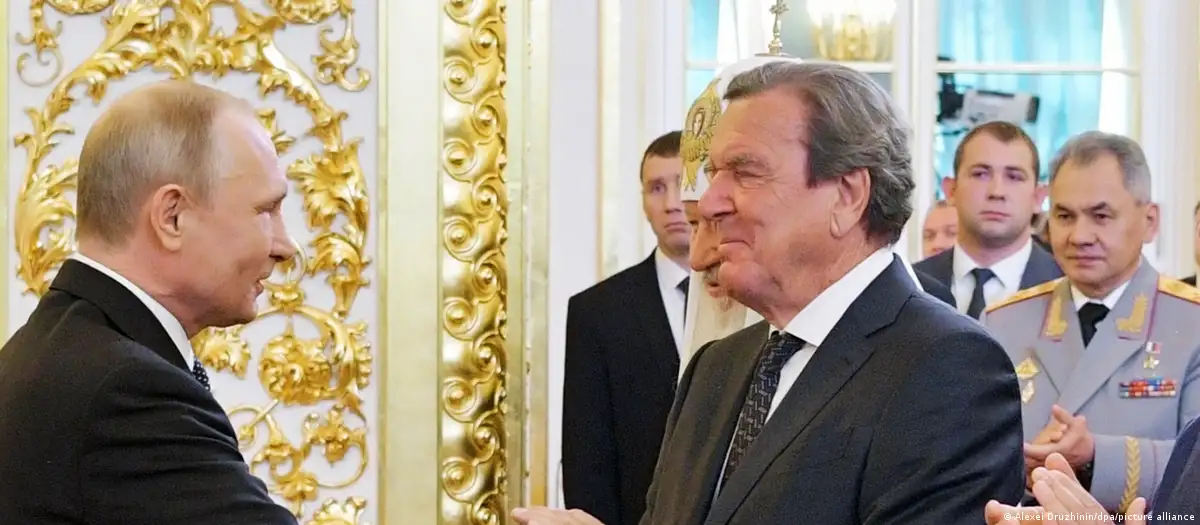
Gerhard Schröder’s office on Sunday refused to comment after Russian President Vladimir Putin said he would like the former German chancellor as a possible European mediator in peace talks to end the Ukraine war.
Putin told reporters on Saturday: “Of all European politicians, I would prefer talks with Schröder.”
The ex-chancellor has maintained close relations with Moscow and is a personal friend of Putin.
Speaking at the end of Victory Day celebrations, the Russian leader also said he thought the four-year conflict with Ukraine was heading toward an end.
In response to a question from DPA news agency, Schröder’s office said it would not comment on the matter.
On Sunday, news agencies cited anonymous German government officials as saying Putin’s suggestion was “not credible” as Moscow had not altered its conditions for ending the war.
The sources added that a first test of credibility would be for Russia to extend this weekend’s 3-day ceasefire.
Schröder defended Russia over Ukraine war
The 82-year-old Schröder has courted controversy over his close ties to Russia, personal friendship with Putin and his role in Russian energy companies after leaving politics.
No tanks: What V-Day parade says about Russia’s military

Writing in the Berliner Zeitung newspaper in January, Schröder described the Russian invasion as contrary to international law.
“But I’m also against demonizing Russia as the eternal enemy,” he added, before urging Germany to restart imports of Russian energy, which were cut over the conflict.
Putin’s remarks come as Kyiv and Moscow observe a three-day ceasefire in the conflict this weekend.
The truce was announced on Friday by US President Donald Trump after negotiations brokered by Washington.
The Financial Times reported this week that European Union leaders are quietly preparing for possible direct negotiations with both sides, citing growing frustration with US efforts.
European Council President Antonio Costa on Thursday said the EU was prepared to hold separate talks with the warring parties “when the right moment comes.”
SPD politicians are divided on Schröder’s suitability
Some senior officials in Schröder’s Social Democratic Party (SPD), a junior partner in Germany’s coalition government, believe his links to the Kremlin make him unsuitable for any mediator role.
“[A mediator] cannot be Putin’s buddy,” Michael Roth, a former SPD lawmaker and chair of the foreign affairs committee, told Tagesspiegel newspaper, adding that any mediator must be accepted by Ukraine.
Others within the party have been more open to Putin’s suggestion, including lawmaker Ralf Stegner, who said the EU needed to play a more important role in peace negotiations.
“If someone like Schröder were to succeed in doing so, it would be negligent to reject it,” he told Spiegel magazine.
Edited by: Louis Oelofse