More Than 600 Killed in Devastating Flash Floods Along Nepal–Tibet Border
More than 600 people have been confirmed dead and nearly 3,000 others remain missing after catastrophic flash floods swept through communities along the mountainous border between Nepal and China’s Tibet region.
Nepal’s disaster-management authority said on Saturday that at least 626 people had died in the country, while 2,426 others remained unaccounted for. Chinese authorities have separately confirmed seven deaths and 554 missing people in Tibet, bringing the combined death toll to at least 633.
Officials have warned that the casualty figures could rise as rescue teams reach remote communities that have been cut off by destroyed roads, collapsed bridges and widespread communication failures. (apnews.com)
The disaster began on Wednesday, August 26, when a glacier reportedly collapsed in the Himalayan mountains, releasing a massive torrent of water, ice, rocks, mud and debris into rivers flowing through Tibet and northern Nepal.
The floodwaters tore through villages and border communities with little warning, destroying homes, roads, schools, health facilities, bridges and hydropower installations.
Gyirong County in Tibet and Nepal’s Rasuwa, Nuwakot and surrounding districts are among the areas most severely affected.
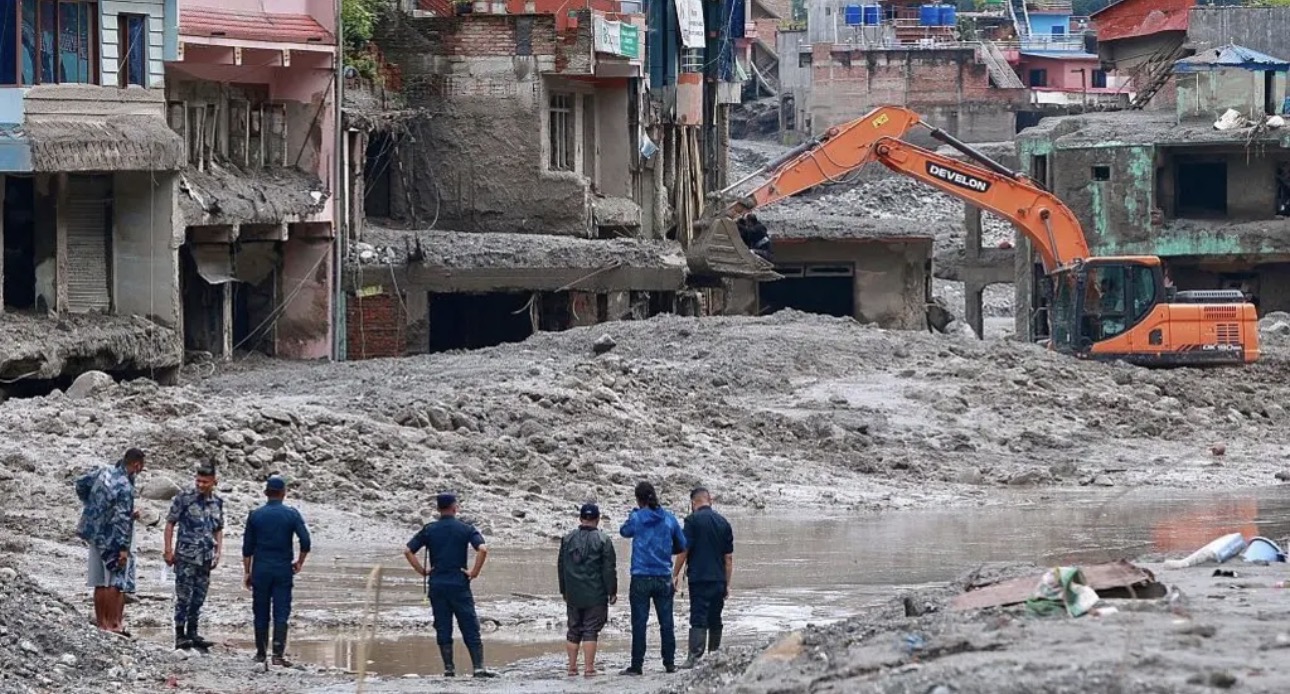
Footage from the disaster zone showed entire settlements buried under mud and debris, while buildings and vehicles were swept away by the powerful current. A Chinese rescue team that reached the devastated Gyirong border-crossing complex reportedly found “nothing but ruins.”
Nepalese security forces and emergency workers have rescued more than 3,700 people since the disaster struck. However, poor weather and difficult terrain have forced authorities to suspend some helicopter operations.
Nepali Army spokesperson Brigadier General Raja Ram Basnet said aerial rescue activities would resume when weather conditions improved.
More than 100 people are also feared trapped inside a tunnel filled with thick mud at a hydropower construction site in Nepal’s Rasuwa district. Rescue workers have been digging through the debris in an attempt to reach possible survivors.
The flooding also created temporary barrier lakes in the mountains, raising fears that further water releases could trigger another wave of destruction. Authorities in Nepal and China are monitoring the lakes through satellite images and ground assessments.
At least 93,000 people are believed to have been affected by the disaster and are in urgent need of food, clean water, shelter, medical assistance and sanitation services, according to humanitarian agencies.
Hundreds of foreign nationals are among those missing. Many were trekkers or Hindu pilgrims travelling towards Mount Kailash and Lake Mansarovar, sacred destinations located in Tibet.
Foreign nationals from India, the United States, Britain, Canada, Australia and several other countries are reportedly among those still unaccounted for.
Hospitals and temporary relief centres in Nepal have been overwhelmed by the number of injured survivors and families searching for missing relatives. Photographs of missing people and unidentified bodies have reportedly been displayed at medical facilities to assist with identification.
Nepal has said it does not currently require general foreign search-and-rescue teams but has requested specialised technical assistance, including support for complex rescues, body identification and the installation of temporary bridges.
The floods have also severely affected Nepal’s economy. Hydropower stations, roads and bridges have suffered extensive damage, disrupting electricity production, trade and transport between Kathmandu and Tibet.
Nepalese Finance Minister Swarnim Wagle estimates that reconstruction could cost between $4 billion and $5 billion—close to 10 per cent of the country’s economy. More than 12 per cent of Nepal’s electricity-generating capacity is believed to have been affected. (reuters.com)
Scientists have repeatedly warned that rising temperatures are increasing the risks posed by melting glaciers and unstable glacial lakes across the Himalayas.
Although investigations into the precise cause of the glacier collapse are continuing, the disaster has renewed calls for stronger early-warning systems, better monitoring of Himalayan lakes and closer emergency cooperation between Nepal and China.
Rescue teams continue to search through mud, damaged buildings and riverbanks as families wait anxiously for information about thousands of missing relatives.
Conversation
- Drop your opinion below.
You must be logged in to comment on this article.
Log In / Register