Xi warns Trump of ‘clashes and even conflicts’ with US over Taiwan
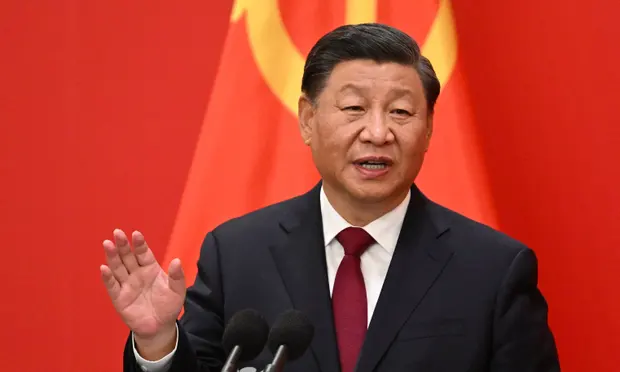
China’s president, Xi Jinping, has warned of “clashes and even conflicts” with the US over Taiwan after meeting Donald Trump in Beijing.
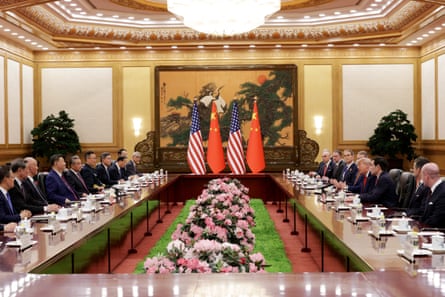
Xi’s remarks, published by China’s foreign ministry after his two-hour meeting with Trump on Thursday morning, said Taiwan was “the most important issue in China-US relations”.
China is keen to put Taiwan at the top of an agenda that risks being overshadowed by the war in Iran and disagreements over trade. Beijing wants the US to reduce its levels of support for the self-governing island, which China claims as part of its territory. Xi has made “unification” with Taiwan a core priority for his legacy and has not ruled out the use of force to achieve that aim.
Trump later said Xi had pledged not to send weapons to Iran, despite recent reports that Chinese arms manufacturers had discussed deals to supply weapons to Tehran.
“He said he’s not going to give military equipment, that’s a big statement,” Trump said, adding that Xi had said it “strongly”. “But at the same time, he said you know they buy a lot of their oil there and they’d like to keep doing that. He’d like to see Hormuz strait opened.”
China has considered sending shoulder-fired surface-to-air missiles called Manpads to Iran via third countries in order to mask their origin, US intelligence officials have said. China has denied the reports.
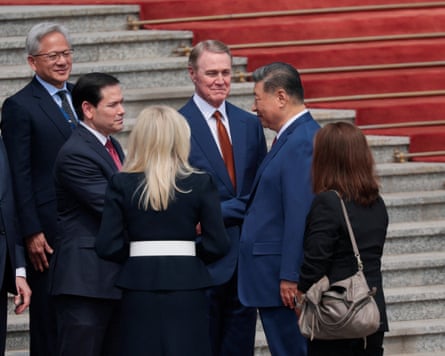
The Chinese government also said the two leaders discussed the Ukraine conflict and issues on the Korean peninsula.
The White House’s readout of the meeting said the two sides also discussed market access for US firms in China, and fentanyl controls, but these two issues were absent from the Chinese readout. The White House said the two countries had “agreed that the strait of Hormuz must remain open to support the free flow of energy” and that Xi had indicated China could buy more oil from the US to lessen dependence on Iran.
Marco Rubio, the US secretary of state, later said the US position on Taiwan was unchanged. He told NBC News: “They always raise it on their side. We always make clear our position, and we move on to the other topics.”
Discussions are not expected to focus, as they have with previous US administrations, on human rights and US-China cooperation on tackling the climate crisis. The US and China together account for nearly half of global emissions.
Maya Wang, the deputy Asia director for Human Rights Watch, said: “President Trump has been pretty hostile to the concept [of human rights] … it would be hard to imagine in a Trump-Xi meeting that human rights would figure meaningfully if at all in their discussions.”
Xi and Trump were meeting in Beijing for a momentous summit that was to pack negotiations on global conflict, international trade and the future of artificial intelligence into just over 24 hours.
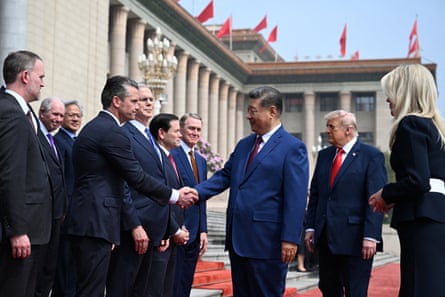
Trump arrived at the Great Hall of the People, an imposing Mao-era building that borders the western edge of Tiananmen Square, on Thursday morning for an opening ceremony followed by face-to-face talks with Xi.
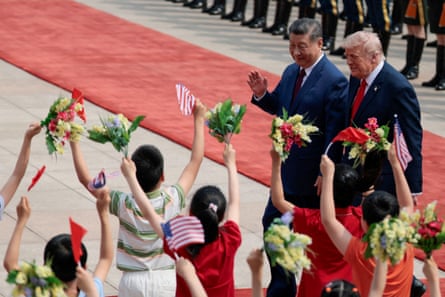
Rows of uniformed officers flanked the red carpet laid out in front of the Great Hall as Xi and Trump walked side by side to a lectern to listen to a welcome salute before being cheered by rows of children waving US and Chinese flags. The children received a double thumbs up from Trump and a wave from Xi.
The ceremony concluded with a tightly choreographed performance from the Chinese military’s marching band before Trump and Xi walked up the stairs into China’s national legislature for their first round of bilateral talks.
In opening remarks, Xi noted that 2026 marked 250 years of US independence and said stability in the US-China relationship was necessary for the world.
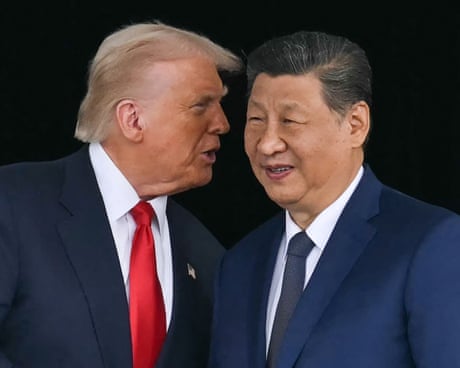
Trump said he and Xi had “known each other for a long time” and Xi was a “great leader”. Trump told Xi: “I say to everybody you’re a great leader. Sometimes people don’t like me saying it, but I say it anyway, because it’s true.”
Xi’s bullish rhetoric on Taiwan echoes language used by China’s foreign minister, Wang Yi, in a recent phone call with Rubio.
Trump’s decision to launch strikes against Iran in February, assassinating the leadership of a country with close ties to China and imperilling global energy supplies, has cast a shadow over talks that were supposed to be focused on reaching a trade deal between the world’s two biggest economies.
Rubio said on Air Force One as the Trump team travelled to Beijing that the US would be pushing Beijing for help on the Iran crisis. “We hope to convince them to play a more active role in getting Iran to walk away from what they’re doing now and trying to do now in the Persian Gulf,” he told Fox News. “[China] is both our top political challenge geopolitically and it’s also the most important relationship for us to manage.”
Beijing hoped to use the meeting to recalibrate US-China ties and set a foundation for a stable and, optimistically, predictable trade relationship going forwards.
Julian Gerwirtz, a former director for China on the national security council, wrote on X: “Xi presents the search for stability as the central strategic dynamic” of the US-China relationship. “China has shifted from playing defense to stalemating the United States,” Gerwirtz wrote.
Xie Feng, China’s ambassador to the US, said in a column published in the Chinese Communist party’s official newspaper on Thursday: “Against the backdrop of escalating international instability, the strategic significance of Sino-US relations is even more prominent.” Xie said non-interaction between the two superpowers was “not an option”.
It is not clear what concrete outcomes will be achieved at this week’s talks. The Trump administration has talked of establishing a “board of trade” with China to address commercial differences between the countries. Beijing wants to push Trump to soften US support for Taiwan through a shift in rhetoric or reducing arms sales to the self-governing island, although many in Beijing concede that this is unlikely.
Trump has also promised to raise the case of the imprisoned Hong Kong media mogul Jimmy Lai.
Despite the trip lasting barely two days, Xi and Trump will have plenty of time for interaction on this visit, the first of up to four presidential meetings that are expected this year. In the afternoon the two leaders toured Beijing’s Temple of Heaven, a Ming dynasty religious complex that has also been visited by Henry Kissinger and Gerald Ford.
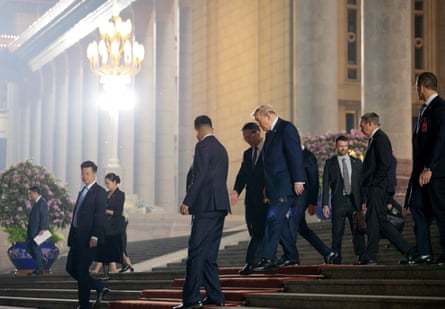
In the evening Trump attended a state banquet at the Great Hall of the People. Roads across Beijing were closed for his motorcade to return to his hotel afterwards, with hundreds of people crowding against barriers to catch a glimpse of their president’s biggest global competitor driving through the Chinese capital.
On Trump’s first visit in 2017, he was the first foreign leader in modern Chinese history to be invited to dine inside the Forbidden City, the sprawling palace complex that housed Chinese emperors for hundreds of years.
There are differences from 2017’s state visit. This year, Beijing appears to have made less effort to ensure blue skies ahead of Trump’s arrival. In 2017, factories were ordered to halt production and heavily polluting cars were banned from the roads in the days before Trump’s visit, in an era in which China had declared war on air pollution and made special efforts to clear the skies before important events such as visits of dignitaries and the Beijing Olympics.
No such efforts have been made this year. The air quality index in the capital was over 150 on Thursday, well above the World Health Organization’s guidelines for healthy air, shrouding the city in a greyish smog full of pollutants that are harmful to human health.
In recent years China’s fight against air pollution has slowed. That is partly because huge improvements have already been made: last year average levels of PM2.5, the most harmful particulate in air pollution, in Beijing dropped to below 30 for the first time since records began more than a decade ago. But heavily polluted skies remain a fairly common occurrence and a visit from the US president is no longer a reason to clear them.
Additional research by Yu-chen Li