Trump administration creates $1.776 billion fund for allies
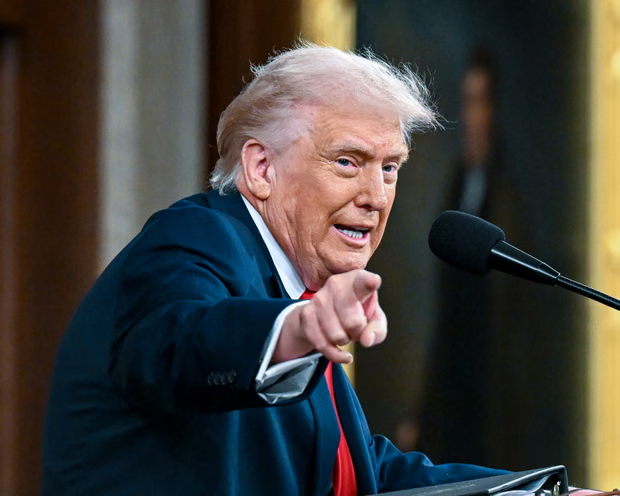
The Justice Department on Monday announced the creation of a $1.776 billion fund to compensate President Donald Trump’s allies who claim they were unfairly targeted by the previous administration.
It’s an unprecedented move that would allow the president’s administration to pay his supporters from a government agency he controls with taxpayer money.
There appears to be few constraints on who can submit a claim to the fund. The president has broadly stated that his allies were politically targeted by the justice system, from the years-old Russian collusion investigation to the nearly 1,600 people charged in connection to the January 6, 2021, US Capitol riot.
Its creation comes as Trump dropped his $10 billion lawsuit alleging that the Internal Revenue Service failed to protect Trump and the Trump Organization from an unauthorized leak of their tax returns.
Trump himself will not receive any payments, but will receive a formal apology, the Justice Department said.
The so-called “anti-weaponization” fund, with its symbolic 1776 figure, is likely to face immediate challenges in court from Democrats and watchdog organizations who say the effort amounts to corruption by allowing the president to enrich allies over what critics they say are unfounded claims of political prosecutions by the Biden administration.
Trump on Monday said that those poised to benefit from the fund were “treated brutally.”
“This is reimbursing people that were horribly treated,” Trump told reporters at the White House. “They’re getting reimbursed for their legal fees and the other things that they had to suffer.”
“The machinery of government should never be weaponized against any American, and it is this department’s intention to make right the wrongs that were previously done while ensuring this never happens again,” acting Attorney General Todd Blanche, who was previously a member of Trump’s personal defense team, said in a statement Monday. “As part of this settlement, we are setting up a lawful process for victims of lawfare and weaponization to be heard and seek redress.”
A commission, made up by five members who have not yet been announced, will run the fund, the department said. Trump will have the power to fire any of the members.
The Justice Department said there are “no partisan requirements to file a claim.” It will process claims through December 15, 2028 – a month before Trump’s second term as president ends.
Mike Lindell, the Trump ally and MyPillow founder, told CNN he expects to be compensated via the fund.
“MyPillow is the most attacked company in history,” Lindell said via text. “My employees that own the company deserve to be made whole!”
In January, Trump, along with his sons Donald Trump Jr. and Eric Trump, sued the IRS and Treasury Department for at least $10 billion. The lawsuit accuses the IRS of an unauthorized leak of their tax returns from his first presidency.
Trump’s lawsuit alleges that the IRS failed to protect confidential tax information and the tax information of the Trump Organization. Charles Littlejohn, a former IRS contractor, was sentenced to five years in prison for leaking Trump’s tax records, along with the records of thousands of others.
Trump sued the IRS in his capacity as a citizen, not as the president.
A spokesperson for Trump’s legal team said in a statement to CNN that the president is “entering into this settlement squarely for the benefit of the American people, and he will continue his fight to hold those who wrong America and Americans accountable.”
Senate Minority Leader Chuck Schumer said that creating the fund is “depraved.”
“Trump is shaking hands with himself in order to fund his insurrectionist army to the tune of billions,” the New York Democrat posted on X. “Of all the corrupt things he has done, this is one of the most depraved.”
“Donald Trump and his compromised Department of Justice have created a slush fund to make pay outs to Trump supporters and cronies,” Public Citizen co-presidents Lisa Gilbert and Robert Wessman said in a statement. “This scheme amounts to the creation of a January 6 payment fund.”
Soon after Trump brought the lawsuit earlier this year, the federal judge presiding over the case in Florida, district Judge Kathleen Williams, expressed skepticism that it was the kind of legitimate legal dispute that belonged in her courthouse.
She asked a group of outside lawyers to brief her on the question. They too raised concerns about the propriety of a president seeking monetary damages for personal reasons against a government agency within his executive branch.
Minutes after Trump’s legal team notified the court he’s dropping the case on Monday, nearly 100 House Democrats submitted a “friend-of-the-court” brief accusing Trump of “blatant self-dealing.”
They wrote that, if Trump sought to voluntarily submit the case to facilitate such a settlement, the court should scrutinize that maneuver under a legal rule that would allow the court to sanction the lawyers involved.
Judge critical of how case ended
Williams late Monday formally agreed to close the case, but criticized the manner in which the controversial litigation came to an end since Trump’s lawyers didn’t say in court that there was a settlement.
“Because the Notice does not reference any settlement or include a stipulation of settlement, there is no settlement of record,” the judge wrote.
Furthermore, Williams noted that the Justice Department, which is meant to be independent, did not lay out in court why it felt a deal was necessary.
“Defendants – federal agencies represented by the Department of Justice, which has an independent obligation to uphold the ‘public’s strong interest in knowing about the conduct of its Government and expenditure of its resources’ and the ‘fair administration of justice,’– neither submitted any settlement documents nor filed any documents ensuring that settlement was appropriate where there was an outstanding question as to whether an actual case or controversy existed,” Williams wrote.
Legal experts had told CNN that, despite the settlement, the judge may be able to still question whether the lawsuit was improperly filed given its unusual nature, but her decision to close the matter ensures those questions will remain unanswered.
Not the first deal
The deal follows several others reached in lawsuits filed by allies of Trump.
In March, the department settled a lawsuit with Michael Flynn. Flynn sued the government for $50 million, accusing the FBI of trying to entrap him in the first few days of the Trump administration. Flynn was awarded over $1 million in the settlement.
Carter Page, a former Trump campaign adviser, also settled a lawsuit with the Trump administration in April. Page was suing the Justice Department and FBI over flawed government surveillance he faced due to Russian contacts in 2016.
Some GOP lawmakers hesitant to back fund
GOPSen. Ron Johnson, a close Trump ally and long-time deficit hawk, backed the president’s move, though most Republicans avoided weighing in directly.
“I think when the federal government abuses citizens, they owe citizens some compensation. So I’m supportive of it,” Johnson told CNN’s Manu Raju on Monday.
But other Republicans were more hesitant to back the fund without any further information.
“I would really have to take a look at it, because I do want to understand the financials behind this. Where is it coming from? Where is it going? We’ve got to start counting those dollars,” said Sen. Joni Ernst, also a deficit hawk.
Pressed by Raju on whether she’s concerned Trump could be paying his allies without congressional oversight, Ernst responded, “We just need to scrutinize the way it’s being presented and what are those dollars going for.”
Sen. John Hoeven, a member of the powerful Senate Appropriations Committee, said he also needed more information and suggested the fund would undergo legal scrutiny.
“You know it’s going to get reviewed and go to the courts and all that. So, we’ll see what happens from there,” he said.
Asked by Raju if lawmakers should review the details, Hoeven responded, “I’m guessing we will, but I really think this is the kind of thing that’s probably going to end up in litigation, and I think, yeah, the courts will decide it. I would guess we’ll take a look at it.”
Sen. John Kennedy told reporters he liked the concept of the fund, but he said, “I like it less if we got to go borrow the money.”
“Who would be eligible to apply, and what’s your metrics? I mean, what’s the definition of being abused by the federal government? Does it happen? Of course, and I think it’s important that we address it, but one thought is that’s why God made courts,” he added.
DemocraticSen. Adam Schiff, who served as a House impeachment manager after the January 6, 2021, Capitol riot, warned that Trump could use the fund to pay ” a lot of violent offenders who attacked this building.”
“It’s bad enough that he pardoned people involved in the first violent attempt to essentially overthrow a free and fair election, but now he wants to pay them. It’s obscene, and it’s all the more obscene when you consider that people are struggling right now,” he said.
On whether it was an impeachable act, Schiff told Raju that lawmakers will have to decide “what remedies are feasible,” adding, “For right now, we all need to be sounding an alarm about this.”
“The American people need to know the president doesn’t give a rat’s a** about them and their problems. He wants to pay off his cronies. He wants to use their money to do it, and I think it’s just awful,” he said.
cnn