UEFA Accuses FIFA of “Selling the Soul of Football” Over $20 Billion World Cup Plan
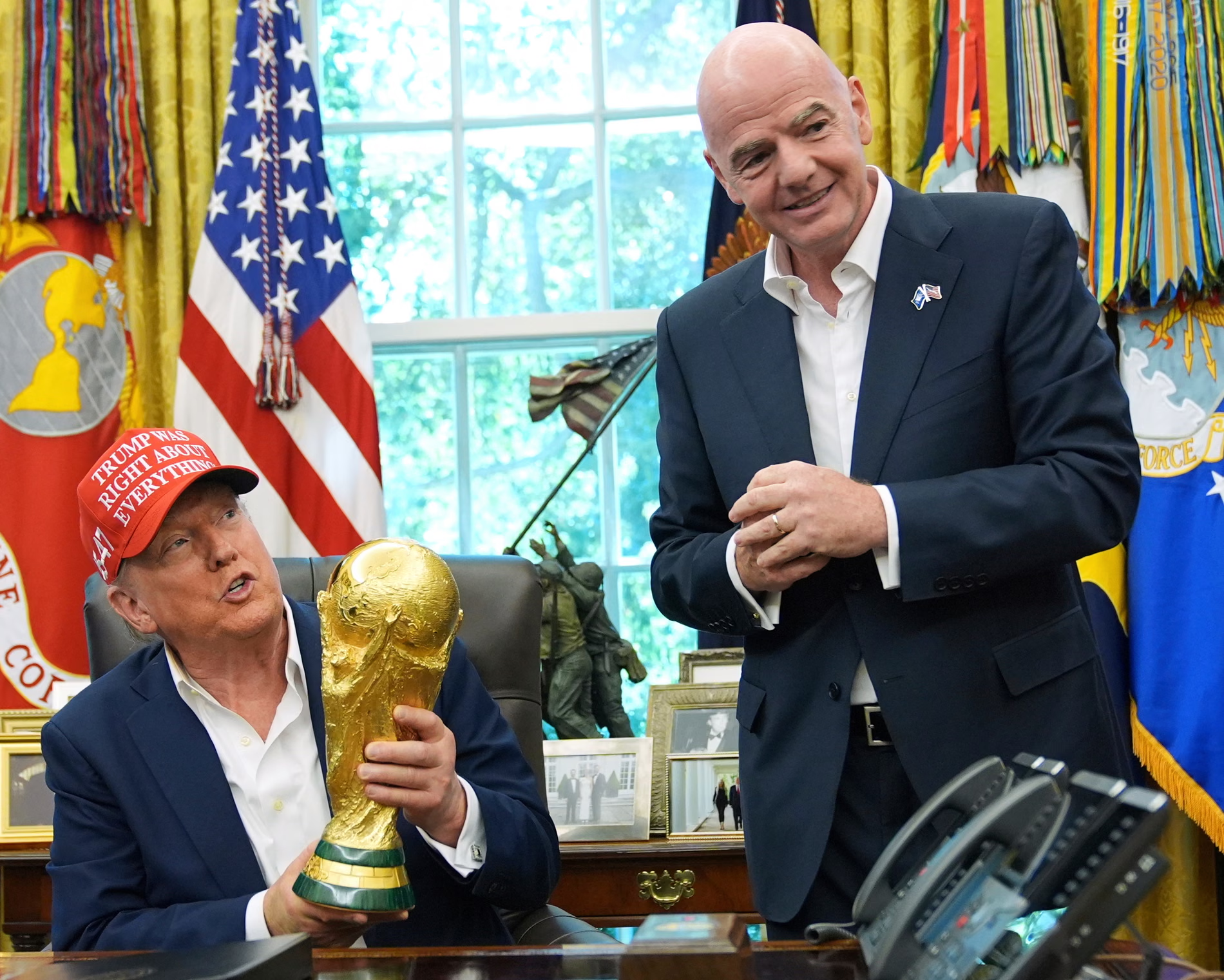
Football’s civil war is back — and this time, the fight is over money on a scale even the sport’s biggest critics didn’t expect. UEFA has led a furious backlash against FIFA president Gianni Infantino after world football’s governing body unveiled plans to sell stakes in a new commercial entity built around the World Cup, valued at a staggering $20 billion.
What FIFA Is Proposing
Under the plan, FIFA wants to create a new commercial subsidiary called the FIFA Forward Enterprise (FFE), consolidating the organisation’s commercial and event operations into a single vehicle. External investors would be invited to buy minority, non-controlling stakes in the FFE, with FIFA looking to raise as much as $4.2 billion from outside capital.
FIFA insists it would retain “exclusive authority” over football governance, competitions, the match calendar, and all regulatory and sporting decisions — meaning, in its telling, the sale is purely commercial and wouldn’t touch how the game itself is run. The organisation says proceeds would go toward increasing funding to each of its 211 member associations, from $8 million a year currently to $20 million for the 2027–2030 cycle, and eventually $24 million by 2035–2038.
Infantino framed the move as an act of expansion rather than a sell-out: football’s popularity, he said, has created remarkable commercial value in parts of the game, and FIFA’s job is to make sure the rest of the sport grows alongside it.
“Football Is Not FIFA’s to Sell”
UEFA wasted no time firing back. In a statement, European football’s governing body said the plan “crosses a line that football’s governing institutions should never cross,” and framed it as a warning to everyone with a stake in the game.
“The soul and governance of football are not assets to trade — especially with zero transparency as to who gains financially,” UEFA said. “None of us are the owners of football. It is not FIFA’s to sell.”
Football historian and Mercy College professor David Kilpatrick noted that FIFA’s commercial relationships aren’t new — its partnership with Coca-Cola, for instance, dates back to the 1970s — but said this proposal takes commercialisation “to a whole other level,” adding that UEFA’s suspicion of selling the soul of the game to private interests is justified.
Timing Makes It Worse
The proposal lands at an especially sensitive moment for Infantino, who has faced a string of controversies through this year’s World Cup cycle — including a US travel ban that affected supporters and officials from several countries, complaints over high ticket prices, and accusations that FIFA bent its own disciplinary rules after a phone call between Infantino and US President Donald Trump reportedly influenced the suspension of a red card given to American striker Folarin Balogun.
Relations between FIFA and UEFA were already strained heading into this announcement — UEFA president Aleksander Ceferin skipped the World Cup final entirely, citing ongoing disagreements over disciplinary procedures, refereeing, and match operations.
Who’s Actually Behind the Money
The proposal has also raised eyebrows over exactly who stands to benefit. FIFA is working with bankers at JPMorgan to bring in outside investors for up to a 20% stake in the new entity, with former Liberty Media chief executive Greg Maffei reportedly advising on the deal. Thrive Eternal — a new investment vehicle from venture capital firm Thrive Capital, founded by Joshua Kushner (brother of Trump son-in-law Jared Kushner) — is expected to be a lead investor, with former Disney chief executive Bob Iger also advising. Thrive Eternal has already taken a minority stake in Major League Baseball’s San Francisco Giants this year.
FIFA has pushed back on the idea that this hands outside interests any real power: “Outside investors will have only a minority stake in FFE and will not play any operational role,” the organisation said. “Equally, they are investing in a subsidiary of FIFA, and not in FIFA itself. For FIFA, nothing changes.”
What Happens Next
The proposal will be presented to FIFA’s 211 member associations and its Council, which holds sole authority to approve or reject the plan. Infantino — who faces re-election as FIFA president next year — has cast the initiative as “the democratisation of football worldwide,” giving every member association a fair shot at the funding on offer.
Whether that argument wins over federations, leagues, and fans already uneasy about FIFA’s direction remains to be seen. What’s clear is that the sport’s governing bodies are once again on a collision course — and this time, the price tag attached to football’s soul has a very specific number next to it: $20 billion.
Source:
nsemgh
Conversation (0)
- Be the first to share your thoughts!
You must be logged in to comment on this article.
Log In / Register